

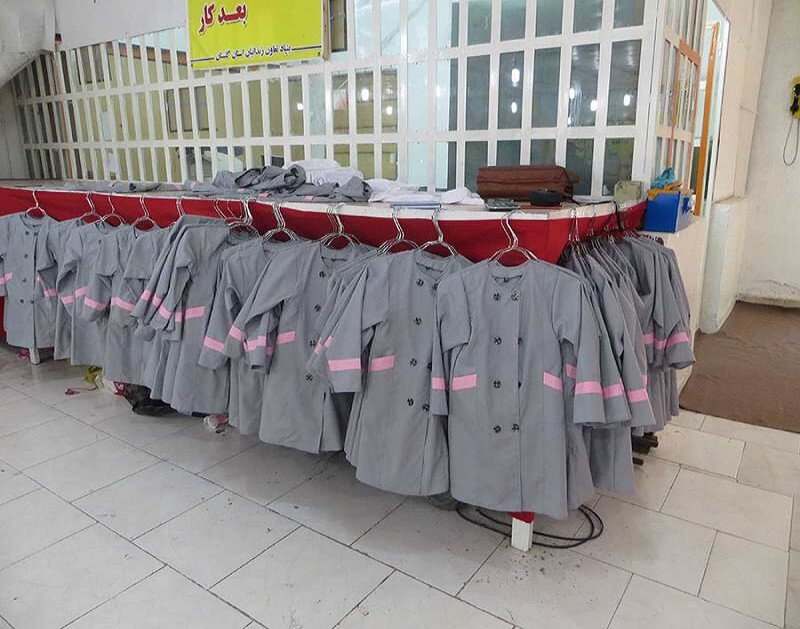
By Shahin Aslani – What was once meant to symbolize discipline and unity in Isfahan’s schools has, for many families, turned into a source of frustration. Parents criticize low-quality fabrics, careless stitching, and outdated designs.
With the start of each academic year, the debate over school uniforms resurfaces. Once regarded as a sign of order, school identity, and protection against class distinctions, uniforms are now seen by many parents less as a cultural necessity and more as an expensive, sometimes pointless obligation.
Three Major Concerns
According to families, complaints center around three key issues:
Prices that exceed the financial capacity of many households.
Poor fabric quality and careless tailoring.
Lack of attention to the needs and tastes of today’s students.
Voices from Parents: From Order to Discontent
Shadi Zarifi, mother of a high school student, believes uniforms are useful in principle, but says her daughter’s coat faded after just two washes, and the fabric wrinkled so badly that even ironing was ineffective. She also highlights the long trips to producers, crowded waiting lines, and late deliveries as part of the problem.
For her, the models and color choices are outdated, monotonous, and ignore the spirit of teenagers.
Ameneh Karimi, mother of two elementary students, told Fooladjan News Agency: “Parents have no role in choosing the color or material; the school simply announces the final decision.” She adds that while her daughter’s uniform was well-stitched, her son’s pants ripped at the seams within weeks. She suggests that only the color be standardized, while fabric and tailoring should be left to families to ensure more durable, comfortable, and affordable options.
Hariri, mother of a fifth-grader, sees uniforms as necessary for instilling discipline, but told Fooladjan News: “The fabrics are mostly synthetic and cause excessive sweating.” She recommends high-quality Tergal fabric, which is durable, easy to iron, and breathable. Still, she finds it unreasonable that a single girls’ uniform in public schools can cost as much as two million tomans given the current quality.
Cheap Fabrics, Careless Tailoring
Problems go beyond fabric. Field observations show many uniforms are rushed with sloppy stitching. Weak seams at stress points like knees, elbows, and pockets, poor-quality thread, and uneven hems around collars and cuffs are frequent issues. These flaws not only undermine appearance but also force families to spend extra on repairs or replacements mid-year.
Education Ministry’s Response: Decisions Are Local
According to Ameneh-Sadat Tabatabaei, head of the Parents and Teachers Association of Isfahan’s Department of Education: “Uniforms are not mandatory, but rather recommended to promote unity and minimize social inequality.”
She explained that colors, designs, and chosen producers are determined locally by each school council along with parent representatives, with no direct interference from the Education Department.
Prices, she said, are registered and approved through the union’s system, and “any orders placed outside the platform are considered violations.” Nearly 200 certified producers are currently active in the system, and late deliveries—if orders were placed on time—can result in daily fines.
Tabatabaei also mentioned a school uniform design competition in Arak, noting that two designs from Isfahan were selected, though adoption remains at the discretion of each school.
Gap Between Official Procedures and Reality
While the official process may appear transparent, parents argue their role in decision-making is minimal. They claim that sample fabrics and designs are often shown before contracts, but the final products rarely match expectations. As a result, the original purpose of uniforms—school identity and a sense of belonging—has been overshadowed by dissatisfaction over cost and quality.
A Call for Redesign with Cultural and Economic Insight
Sara Oshaghi, a fashion design expert, told Fooladjan News: “Redesigning uniforms with human, cultural, and economic perspectives could transform them from a controlling tool into a means of strengthening collective identity and respect for diversity.”
She emphasized that uniforms are more than identical outfits—they are part of a school’s visual identity and culture. Fabric quality and color choices, she noted, directly affect not only appearance but also students’ physical comfort, psychological well-being, and academic performance.
Using breathable, durable fabrics, she said, would reduce sweating, discomfort, and distraction, thereby improving focus in class. In contrast, cheap synthetic fabrics often cause skin irritation, restlessness, and poor concentration.
Regarding color, Oshaghi argued that dark, dull shades are mismatched with children’s energy, and that schools should instead introduce brighter, more inspiring tones within educationally appropriate standards.
For her, aligning quality and design could turn uniforms from short-lived consumer goods into cultural and educational assets. She recommends that schools consult fashion design experts before signing contracts with producers to ensure durability, aesthetics, and psychological comfort.
The Same Story, Year After Year
Despite oversight systems, fines for late producers, and new design proposals, parental complaints about high costs and poor quality persist. For many families, the uniform issue repeats annually: long queues at factories, wrong sizes, cheap fabrics, and styles far removed from the spirit of today’s children.
The question remains: Will school uniforms continue to symbolize order and identity, or remain a financial burden for families? Parents say they have been waiting years for an answer.